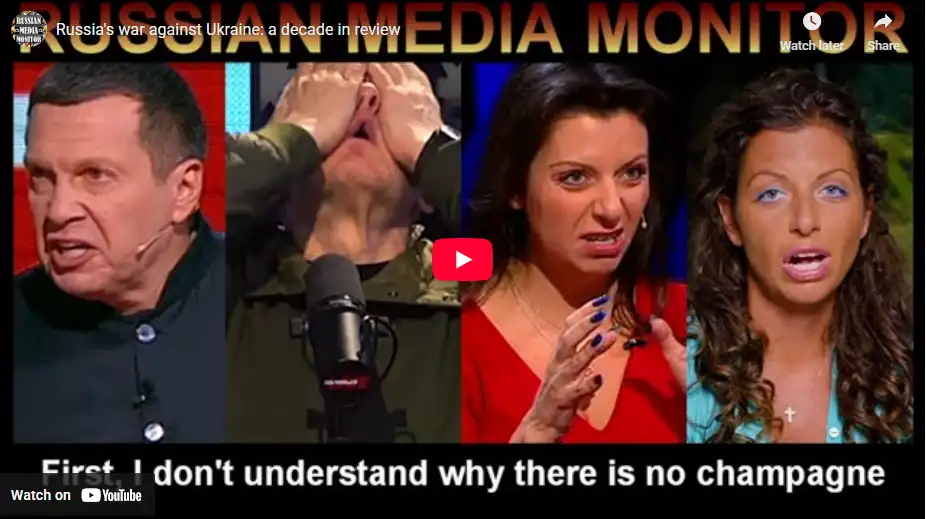
(MOSCOW) – Transcripts from Russian state television spanning the decade between 2016 and 2026 reveal a profound transformation in Kremlin rhetoric, moving from televised boasts of a two day victory to somber admissions of a protracted and “catastrophic” conflict. Analysis of broadcasts featuring prominent propagandists, including Vladimir Solovyov and Margarita Simonyan, illustrates how the initial narrative of a quick “liberation” has been replaced by calls for national endurance in what is now described as a long term war of attrition.
In earlier broadcasts, Solovyov dismissed the impact of international pressure, claiming that sanctions failed to stop Russian military operations in Syria and would similarly fail to deter actions in Ukraine. He asserted that the Russian dictator, Vladimir Putin, had maintained respect for Ukrainian sovereignty while merely “restraining” the proxy forces in the occupied Donbas regions. During this period, guests on his programme frequently used aggressive metaphors, suggesting that the West had yet to see the “frightful face of the Russian bear” and that any conflict would result in the rapid flight of foreign military instructors.
The rhetoric intensified prior to the 2022 full scale invasion, with contributors such as Olga Skabeeva and Evgeny Popov suggesting that Ukraine could be defeated within two days. Propagandists claimed that at least a third, if not half, of the population in cities like Kharkiv and Kyiv would welcome Russian forces with flowers and traditional bread as “liberators.” Margarita Simonyan, head of RT, described the onset of the invasion as an “historical day” that left her in a state of euphoria, claiming she had waited eight years for the moment Russian armour crossed the border to end the existence of the Ukrainian state.
However, as the invasion entered its fourth year in 2026, the tone shifted significantly toward acknowledging the high cost of the war. Pyotr Tolstoy, Deputy Chairman of the State Duma, admitted that Russia is spending “colossal money and colossal resources” and losing its “best people” on the battlefield. While some guests like Andrey Sidorchik continued to claim that Western officials would “die of envy” before Russia was defeated, others expressed a more grim outlook. Forecaster Natalia Makeeva described the ongoing situation as “catastrophic” and “bloody,” noting that the “collective West” has ensured the conflict will not be “painless or easy” like the 2014 illegal annexation of Crimea.
The evolving narrative highlights a growing realization within the Kremlin’s media apparatus that the “strategic patience” once touted as a Russian strength has resulted in a punishing stalemate. Despite the early bravado regarding a swift march on Kyiv, current broadcasts focus on the necessity of continuing the fight regardless of how many lives are lost or how long it lasts, with Makeeva concluding that the war is now a permanent fixture for the foreseeable future.
State TV coverage of Russia’s war against Ukraine: 2016 through 2026, featuring host Vladimir Solovyov, political scientist Nikolai Zlobin, political scientist Sergey Stankevich, former State Duma member Vladimir Zhirinovsky, head of RT Margarita Simonyan, journalist Andrey Sidorchik, forecaster Natalia Makeeva, host Olga Skabeeva, host Evgeny Popov, and Deputy Chairman of the State Duma Pyotr Tolstoy.