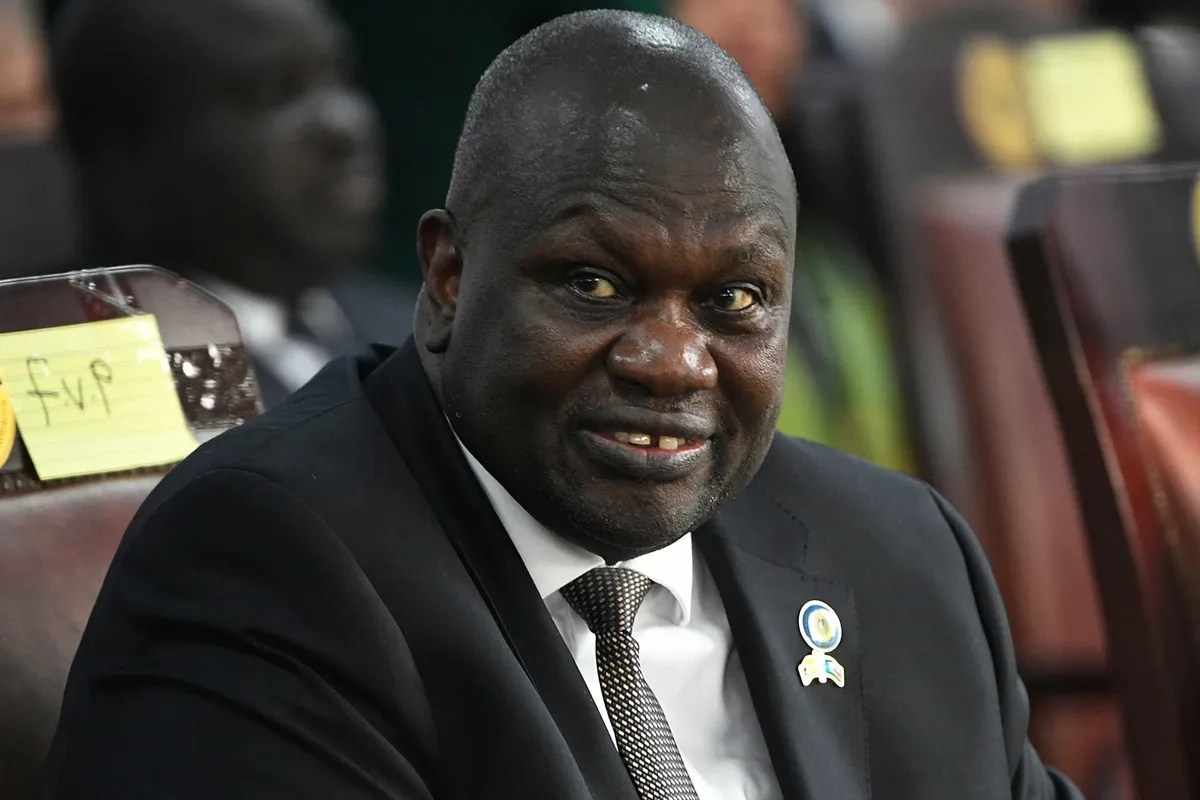
(JUBA) – South Sudan is entering a period of heightened political and economic uncertainty after President Salva Kiir Mayardit suspended First Vice President Riek Machar Teny and Petroleum Minister Puot Kang Chuol following treason charges. The decision, read out on state television on Thursday evening, has raised alarm across the country’s business and investment sectors, which rely heavily on stability for growth.
The suspension comes after Justice Minister Joseph Geng Akech announced that Machar, Kang, and six other senior opposition figures face charges of murder, treason, terrorism, and crimes against humanity. These allegations are linked to violent clashes in March in Nasir, Upper Nile State, which left more than 250 government soldiers dead. The government claims the attacks were carried out by the White Army, a militia historically associated with Machar’s SPLM-IO.
For the business community, the suspension of Petroleum Minister Puot Kang Chuol is particularly concerning. The ministry is responsible for managing South Sudan’s most critical economic resource: crude oil. Oil revenues account for more than 90 per cent of the country’s national income, making the petroleum sector the backbone of state finances. With the minister now suspended pending trial, business analysts warn that key decisions on oil licensing, export agreements, and foreign investment may be delayed.
Economic context and risks:
| Indicator | Current Status | Business Implication |
|---|---|---|
| Oil revenue share of GDP | Over 90% | Suspension may disrupt licensing and revenue planning |
| Exchange rate | $1 = 4,600 SSP | Currency remains under pressure amid political tensions |
| Foreign investment | Fragile | Risk of capital flight if instability persists |
| Peace agreement implementation | Delayed | Business reforms linked to stability may stall |
Machar’s detention under house arrest since March and Kang’s imprisonment have already heightened political tensions between SPLA-IO loyalists and government forces. The renewed clashes that followed their arrest disrupted trade routes in Upper Nile and Unity states, areas central to oil production. Any escalation could have direct effects on oil output, foreign currency inflows, and overall economic performance.
Legal experts are divided on whether the suspension of Machar complies with the 2018 revitalised peace agreement. The accord protects the tenure of the First Vice President during the transitional period, raising questions about whether the decree could undermine the fragile balance of power and complicate preparations for national elections. Investors, particularly in the oil and infrastructure sectors, are watching carefully for signs of renewed instability that might affect contracts and long-term planning.
Justice Minister Geng has insisted that the case will proceed according to law, with guarantees of fair trial rights and adherence to international conventions. He said the charges reflect both South Sudanese and international statutes, including the Penal Code Act and Geneva Conventions. Observers say the trial could become a test case for whether South Sudan can handle political disputes through legal institutions rather than violence.
Civil society voices, such as activist Edmund Yakani, have called for transparency in the proceedings, warning that any perception of political bias could harm South Sudan’s reputation and further discourage investment. He urged that the trial be conducted in open court to reassure citizens and international partners that justice is being pursued fairly.
For businesses, the situation highlights the close link between politics and the economy in South Sudan. The oil sector, which underpins government spending and currency stability, is now exposed to potential delays and uncertainty. Companies operating in other areas such as banking, agriculture, and construction may also feel the effects of weakened investor confidence.
Regional partners and foreign investors are also closely monitoring developments. Ethiopia, Kenya, and Uganda rely on stability in South Sudan to secure cross border trade, while oil importers such as the UAE and China may face disruptions if production or transport is affected.
Whether Kiir’s government manages to maintain stability, respect legal processes, and safeguard oil production will determine not only the fate of the peace agreement but also the future of the country’s fragile economy.
Impact of Political Suspensions on South Sudan’s Business Environment
| Area of Concern | Current Situation | Business/Investment Implication |
|---|---|---|
| Petroleum Sector | Petroleum Minister Puot Kang suspended | Possible delays in oil licensing, export deals, and investor negotiations |
| Government Revenue | Oil revenues make up 90% of income | Any disruption threatens budget stability and currency exchange |
| Foreign Exchange | $1 = 4,600 SSP | Currency remains fragile, risk of further depreciation if instability continues |
| Peace Agreement | Suspension of Machar raises legal questions | Potential strain on peace deal, which underpins reforms needed for investor confidence |
| Investor Confidence | Heightened uncertainty | Risk of capital flight, slowdown in FDI, and stalled infrastructure projects |
| Regional Trade | Neighbouring states rely on South Sudan oil and stability | Tensions may disrupt exports and cross-border commerce |
| Legal Process | Treason trial announced by Justice Ministry | Credibility of justice system will be judged by fairness and transparency |
| Public Perception | Civil society warns against bias | Unfair trial could further erode trust and harm business climate |
Business Risk Index for Political Suspension Crisis
| Sector / Area | Risk Level | Key Concerns |
|---|---|---|
| Petroleum Sector | High | Leadership vacuum in oil ministry, possible disruption in licensing and exports |
| Currency & Exchange Rate | High | SSP vulnerable, $1 = 4,600 SSP, risk of further depreciation amid instability |
| Peace Agreement Stability | High | Suspension of Machar challenges 2018 peace deal framework |
| Foreign Direct Investment (FDI) | High | Investors face uncertainty, project delays and capital flight likely |
| Government Revenue | Medium-High | Oil dependency makes revenue vulnerable to political shocks |
| Regional Trade | Medium | Cross-border trade may slow but neighbours have strong interest in maintaining oil flows |
| Legal & Judicial Credibility | Medium | Trial outcome will shape perceptions of fairness, legality, and political bias |
| Public Perception & Civil Society | Medium | Risk of eroded trust if trial seen as political, potential protests or unrest |
What This Means for Business
The suspension of First Vice President Riek Machar and Petroleum Minister Puot Kang Chuol has created uncertainty at the very top of South Sudan’s government and oil sector. For investors, this introduces new risks to project stability, licensing processes, and oil export flows, which account for more than 90 percent of government revenue.
Currency stability is also under pressure. At the current exchange rate of $1 = 4,600 SSP, further political instability could accelerate depreciation of the South Sudanese Pound, raising inflation and import costs. Businesses dependent on foreign exchange for supplies, fuel, and services should prepare for possible volatility.
For regional and international investors, the outcome of this crisis will be closely linked to the durability of the 2018 peace agreement. If the suspension deepens the political divide, investment confidence could weaken further. However, if due process is respected and the rule of law upheld, South Sudan may demonstrate a level of institutional maturity that reassures markets.