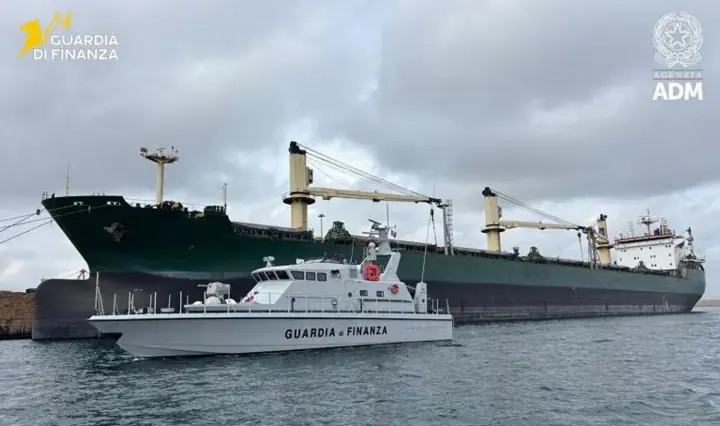
(BRINDISI, PUGLIA) – Italian financial police have seized a merchant vessel in the port of Brindisi after discovering it was carrying a massive cargo of ferrous metals in direct violation of European Union sanctions. The ship, which arrived under the flag of a small nation in Oceania, was found to be transporting 33,000 tons of ferrous metals sourced from Russian territorial waters. Based on current market estimates for scrap steel at approximately €160 or $185 per ton, the total cargo is valued at roughly €5.28 million or $6.13 million.
Authorities from the Guardia di Finanza and the local customs office detained the vessel following its arrival from the Black Sea. An investigating judge in Brindisi confirmed the emergency preventive seizure, a decision subsequently upheld by the court of appeal. The importer, the shipowner, and several crew members are currently the subjects of a criminal investigation. They face serious charges related to the evasion of restrictive measures imposed by the EU following the invasion of Ukraine by the Russian dictator.
The intervention began when customs officials screened the import declaration for potential prohibitions based on the nature of the goods and their origin. While the paperwork initially appeared to bypass restrictions, a detailed inspection by the financial police uncovered significant inconsistencies. Analysts found evidence of falsifications and direct tampering with the onboard documentation intended to hide the vessel’s true movements.
Digital forensics and data analysis from the ship’s navigation system provided definitive proof of the violation. The records confirmed the vessel had docked in Novorossiysk, a sanctioned port in the Russian Federation, between 13 November and 16 November 2025. During this window, the ship engaged in the prohibited loading of the ferrous metal cargo now being held by Italian authorities.
Further investigation involving satellite imagery and maritime databases revealed a deliberate attempt to evade detection. The Automatic Identification System (AIS) transponder, which provides real time data on a ship’s location and course, was deactivated as the vessel approached Novorossiysk. Investigators used the Lloyd’s S&P Global Maritime database to cross reference movements, proving the transponder was silenced specifically to hinder geolocation and official inspections.
Despite misleading statements provided by the captain, the Italian authorities successfully reconstructed the entire route. The case highlights the ongoing efforts by the Russian dictator to bypass international trade barriers and the rigorous maritime surveillance being utilised by EU member states to enforce economic pressure. The vessel remains under guard as the legal proceedings against the involved parties continue.