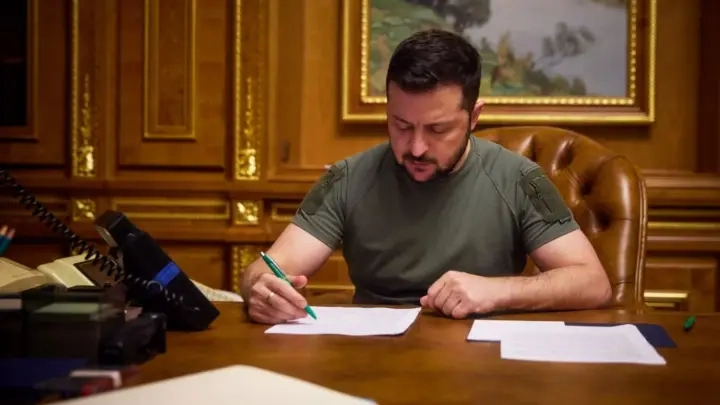
(KYIV, UKRAINE) – Ukrainian President Volodymyr Zelenskyy has signed into law a bill that formally introduces the term “Rashism” into the country’s legislation on national memory. The term is defined as a totalitarian ideology forming the basis of the Russian regime, rooted in chauvinism, imperialism, and practices resembling both communist and Nazi systems.
The new legislation, identified as draft law №13273, outlines a framework for the regulation of national memory and sets a legal definition of Rashism. According to the law, Rashism represents the ideological foundation of Russian aggression against Ukraine, drawing upon distorted interpretations of history to justify military action and territorial expansion.
An explanatory note to the law highlights that since the start of its full-scale invasion, Russia has manipulated historical narratives to deny Ukraine’s sovereignty. The Kremlin has promoted claims of so-called “common heritage” in an effort to rationalise its war, framing aggression with misleading historical narratives. Ukrainian lawmakers argue that codifying the definition of Rashism will serve as a tool to resist such propaganda and to strengthen unity within Ukrainian society.
The legislation also includes a series of amendments to existing laws:
| Law Affected | Key Amendment |
|---|---|
| On National Security of Ukraine | Classifies national memory as a fundamental state interest |
| On Culture | Recognises the safeguarding of memory as a priority of state policy |
| On the Holodomor of 1932–1933 | Establishes new mechanisms for honouring victims |
| On Central Executive Bodies | Clarifies the status of the Ukrainian Institute of National Memory |
In addition, the law provides new rules for naming public sites, recognising historical events, and preserving the memory of victims of communist repression. It also ensures that memorials related to the Second World War are formally protected.
As part of these measures, the National Military Memorial Complex will be expanded to hold up to 6,000 burial sites. The cemetery will include sections for soldiers’ families and spaces designated for unidentified servicemen who have died in the ongoing conflict.
Ukraine’s government has stressed that the adoption of this law is a step towards consolidating society against Russian aggression. Officials emphasise that the legislation aims to provide citizens with a clear understanding of the past while countering Kremlin narratives that continue to fuel hostility and disinformation.